Orbiter 2010 Shuttle Fleet Download
Screenshot of a Space Shuttle lift-off from Martin Schweiger () Release Latest stable release 30 August 2016, Orbiter2016 Mode(s) Orbiter is a program developed to simulate using realistic. The simulator was first released on 27 November 2000; the latest edition, labeled 'Orbiter 2016', was released on 30 August 2016, the first new version of the simulator since 2010. Orbiter was developed by Dr. Martin Schweiger, a senior research fellow in the computer science department at, who felt that space flight simulators at the time were lacking in realistic -based flight models, and decided to write a simulator that made learning physics concepts enjoyable. It has been used as a teaching aid in classrooms, and a community of add-on developers have created a multitude of add-ons to allow users to fly assorted real and fictional spacecraft and add new planets. Contents • • • • • • • • • • • • • About the simulator [ ] Features [ ] Orbiter is a realistic physics simulator which allows users to explore the in a number of, both realistic, such as the; and fictional, such as the 'Delta-Glider.'
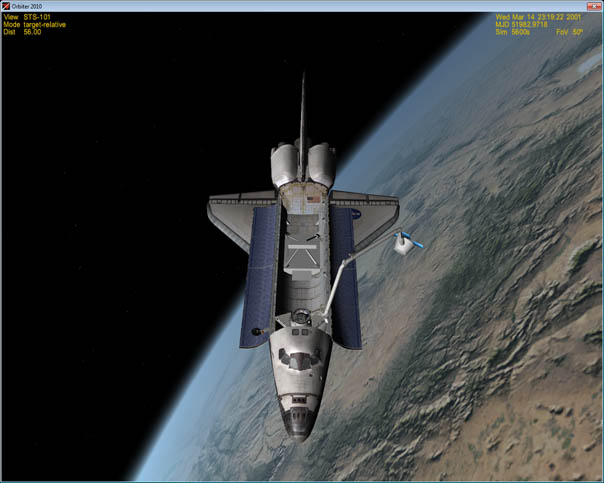
Speaking of flying the shuttle in Orbiter, there's a brand-new edition out of the amazing Shuttle Fleet add-on for Orbiter 2010-P1 (Shuttle Fleet 4.7 by David413). I've only just downloaded and installed it, but it looks great. It includes support for local light sources which should improve the already impressive.
Schweiger has included fictional spacecraft to allow for easier flights for less experienced users. The simulator is realistic enough to re-enact historical space flights, and the ability to fly fictional ships also allows the player to reach areas of the solar system that cannot be reached by manned spaceflight at the present time. A spacecraft's engines are defined only by the amount of thrust they put out and amount of fuel they use, allowing anything from to conventional to futuristic and drives to be simulated. Everything between ground movement and interplanetary travel is supported, including orbital and sub-orbital flight, although only vessel-ground collisions are supported. Docking and attachment systems allow the user to simulate docking with a or other spacecraft and rendezvous with and retrieval of.
Users can also build in orbit. The solar system presented in Orbiter consists of the, the eight and their major. Many,, and not included in the simulator are available as add-ons. Although Orbiter contains a database of over 100,000 stars, these are for display purposes only and is currently not possible in the simulator.
The simulator also includes a planetarium mode that allows and grids to be overlaid onto the star map, along with labels of the and other celestial markers. The planetarium mode can also display labels indicating the location and identity of objects in the solar system, such as planets, moons, or vessels, that appear within a certain proximity based on their type. This mode can also display labels on the celestial bodies in the solar system at certain coordinates on their surface for indicating cities, historical markers, geological formations, and other interesting sites. A Deltaglider docked to the, demonstrating Orbiter's atmospheric visual effects. The traditional simulated control interface in Orbiter consists of two and a.
Each features several modes of operation, with all commands given via the or mouse. The simulator also supports customized control panels and instruments, including 3-D virtual cockpits and 2-D instrument panels.
These allow the player to use the mouse to interact with the panels, and allows more complex systems and instruments that are customized for each ship. The addition of a virtual also allows the player to freely look around from the perspective of the pilot.
From patch 060929 onwards, Orbiter has supported, which allows the simulator to track the head-movements of the player and adjust the view accordingly. Realism [ ] Orbiter was developed as a realistic, with accurately modeled planetary motion, effects (including non-spherical gravity), free space, atmospheric flight and. The position of the planets in the solar system is calculated by the solution, while the Earth-Moon system is simulated by the model. Only are simulated, not taking into account. This means that phenomena such as due to are not simulated, although situations where this is noticeable are very rare. The default version of Orbiter has no sound, however a popular add-on called 'OrbiterSound' is available.
It provides engine noises, ambient sounds in the cabin, radio chatter and other sounds including mp3 playlists. Options enable the user to maintain a realistic silence when the craft is viewed externally during space flight. There is no collision detection for objects in space, apart from defined docking ports. Included spacecraft [ ] Orbiter's standard distribution includes real and fictional spacecraft and space stations: Real vessels [ ] The Orbiter version of the Space Shuttle Atlantis, a retired Space Shuttle orbiter formerly operated by, and the only player-controllable spacecraft based on a real world design that is included with the basic installation of Orbiter. Orbiter's model of the historic Russian space station.
Unlike its real counterpart, it was not deorbited and is placed in an orbit which is closer to the ecliptic plane. This was done initially to make Mir a good origin of interplanetary flights in earlier versions of Orbiter, when Orbiter also automatically refueled spacecraft on docking with a space station.
Using the scenario editor, it's still possible to refuel in-flight or start the simulation docked and with full tanks. However, it is possible to move Mir into the correct orbit. In a similar orbit as the real ISS and in a completed state, it shows modules which are no longer planned to be installed on the real ISS. A model of the real HST, it gets used together with Orbiter's Space Shuttle Atlantis. Satellite Like the Hubble Space Telescope, it's one of the example payloads for Orbiter's Space Shuttle. Fictional vessels [ ]. The Delta Glider in low Venusian orbit, showing the 3D Virtual Cockpit, including Multi-functional displays (MFDs) and the Head-up Display (HUD) Delta-glider Mk.4 A delta wing, which is rather easy to fly and thus good for the first steps into Orbiter.
A variant of the Delta-glider Mk.4 is also included, the Delta-glider-S, which trades some of the propellant capacity for a propulsion system, at the cost of requiring fuel from the main engine fuel tank. It's possible to travel from Earth to Mars with the Delta-glider, making it possible to practice interplanetary missions. It is technically a spaceplane. Shuttle-A A small space freighter, which can transport six large cargo containers with a total mass of 120 metric tons.
It doesn't have an aerodynamic hull so it is at home on the Moon and Mars. While it is possible to launch and land the spacecraft from earth, particularly when empty, the lack of aerodynamic lift coupled with Earth's high gravity and thick atmosphere make this a difficult and fuel-costly operation.
Its cargo containers are however equipped with automatic parachutes. Using the parachutes, it's possible to simulate a cargo run from a lunar base to Earth and back, dropping the cargo while still in the upper atmosphere.
Its high inertia and inferior aerodynamics make it harder to fly in an atmosphere than the Delta-glider. Shuttle-PB A small personal spacecraft, with high agility and a futuristic performance. As its main purpose is to serve as simple SDK example for add-on developers, it lacks many complex details of other included ships in Orbiter like 2D or 3D cockpits or animations. Dragonfly A complex manned space tug for the construction of space stations. It simulates its various subsystems at a higher complexity than all other standard spacecraft in Orbiter, being a good example of the technical possibilities of Orbiter's SDK. Its flight model is also within the possibilities of current technology, making it a so-called 'nearly realistic' spacecraft. Luna-OB1 A fictional wheel shaped station in lunar orbit, inspired by from the beginning of.
As a rotating space station, it is a challenge to dock with it. Carina A small fictional science satellite, which is used as payload on Orbiter's Space Shuttle. It is a completely inert payload currently. It is based on a proposed European re-entry capsule experiment, to be launched on the, which later resulted in the. Orbiter add-ons [ ]. Orbiter recreation of a launch using an add-on that recreates the mission. While the source is not editable, an extensive enables Orbiter users to contribute by creating add-ons. Mogra Na Phool Sakhi Mp3 Free Download.
Many spacecraft are available for download as add-ons, ranging from the to and the. Another popular category of add-ons are modifications of the standard spacecraft of Orbiter, ranging from simple visual changes to complex simulations of the internal subsystems of these fictional crafts. Examples of these more advanced default spacecraft include the DeltaGlider IV and the XR Series of vessels. Add-ons are also available for new surface bases, modes, extensions of the simulation menu, space stations, planets, and even other planetary systems.
Since Orbiter 2006, a scenario editor is included, which can also be extended for supporting the special attributes of add-on vessels. See also [ ] • • • • • • Notes [ ]. Retrieved 2010-08-05. Retrieved 2010-08-05. Retrieved 2010-08-07.
Retrieved 2009-04-17. Retrieved 2010-08-07. Retrieved 2010-08-05. Retrieved 2010-08-07. Retrieved 2010-08-07. Retrieved 2010-08-07.
• 'Orbiter Technical Notes: Dynamic State Vector Propagation', Martin Schweiger, 2006 • P. Bretagnon and G.
Francou, (PDF 840KB), Astronomy & Astrophysics 202 (1988) 309–315. Retrieved 2010-08-07. Retrieved 2008-06-28.
Retrieved 2008-04-05. Retrieved 2007-12-21. Retrieved 2007-12-21. Rodriguez At His Best Rar. Retrieved 2008-06-28. Retrieved 2015-02-01.
Retrieved 2010-08-27. References [ ] Manuals and Technical Papers [ ] • - current manual for Orbiter • - general presentation of Orbiter presented by the author at the 2nd Workshop on Astrodynamics Tools and Techniques at the • - Presentation of the recent technical developments in Orbiter, held by the author at the 3rd International Workshop on Astrodynamics Tools and Techniques at the. • Paton, M (2007), (PDF). Archived from (PDF) on March 19, 2009. Retrieved 2008-06-28., presented at the International Space Development Conference (ISDC) 2007 in Reviews and Interviews [ ] • on • External links [ ] • - Contains download and install instructions, galleries, news, links to other forums/download sites etc. • - The main forum for addon development, help, and discussions relating to Orbiter.
• - The largest Orbiter addon repository. • - Official Orbiter wiki project. • - Contains all current downloads of Orbiter and (high resolution) files. Also links to other forums/download sites etc.
Orbiter can be hard to get into, and needs modding just for basic functionality like sound, but it's interesting to note that HarvesteR played Orbiter and later developed KSP as being more accessible. Rather than learn from Orbiter, I've found that the orbital mechanics I've learned from KSP can be used in some other games such as Pioneer, the tools are crude but you can see your orbit, and with some guesswork you can raise and lower your apo/periapsis, change inclination and even do a transfer orbit to the Moon, all thanks to KSP. I am one of those that arrived to KSP with a rather solid experience in Orbiter (since 2002). Almost any maneuvers I make in KSP, I did with Orbiter years before and practiced many times, therefore I must say yes, Orbiter allowed me to play KSP with ease. I am still using in KSP a similar approach as I had with Orbiter, so to plan in advance and make any maneuver to the utmost precision, though KSP allows greater margin for errors and its simplified universe is easier to navigate (just move KSC far from the equator and tilt the rotation axis of each body, to imagine how simpler it is). Orbiter can be hard to get into, and needs modding just for basic functionality like sound, but it's interesting to note that HarvesteR played Orbiter and later developed KSP as being more accessible.
Rather than learn from Orbiter, I've found that the orbital mechanics I've learned from KSP can be used in some other games such as Pioneer, the tools are crude but you can see your orbit, and with some guesswork you can raise and lower your apo/periapsis, change inclination and even do a transfer orbit to the Moon, all thanks to KSP I just checked in with Pioneer last week (first time since before I bought KSP) and the first thing I did was play around to see if I could orbit Never realised it had such realistic physics. I wonder if you could orbit in the original Frontier Elite 2. Oh, and might i add, orbiter is hard, like if your a ksp noob, then orbiter will be near impossible, but i played orbiter at the same time i got into ksp, about 2 years ago, only in the past few months have i been investing serious time into orbiter thought. Its really fun to be able to use real spacecraft, and have more of a challenge to navigate and acheive your goals. My primary reason for playing orbiter though, is becuase i wanted a realistic shuttle simulator, and most of my time playing orbiter is spent in endeavour and atlantis! Also, flying the SS in venus is pretty neat too. (used hacks to get there, just for the fun of it).
Check out ISS v3.2(I think it's 3.2) There should be a link to the Soyuz FG/U LV and spacecraft that is made to work with it. Shuttle fleet v4.8 is also pretty great. Yes, I have that. Partly textured rockets (block colour on many parts), no interior, not updated for 4 years.
On the whole graphics that wouldn't look out of place in flightsim 98 This is my point, orbiter was great back in 2004 but that was 10 years ago and its looking really old now, and development has slowed to a snails pace (mercury / gemini last updated 8 years ago!). This is why I love KSP, its well made and has a great modding community and has modern graphics. I'd love to see a new real world sim released that uses modern graphics. Orbiter 2014? Orbiter was great back in 2004 but that was 10 years ago and its looking really old now, and development has slowed to a snails pace (mercury / gemini last updated 8 years ago!).
This is why I love KSP, its well made and has a great modding community and has modern graphics. I'd love to see a new real world sim released that uses modern graphics. Orbiter 2014? You are certainly right on about everything, IMO.
Development with Orbiter seems to be very slow (though still the community there is pretty active). Certainly, if a 'Orbiter 2014' was to be released (not that I can find any sign about that) it should also have improved graphics (worthy of the performance offered by more modern GPU, that could not be achieved some years ago). Anyway, I always loved, and still do, the high definition texture packs with the planetary bodies; and about the internals, I finished to almost always use either DG-4 or AMSO, just because at least there was something decent with those.
Yes, I have that. Partly textured rockets (block colour on many parts), no interior, not updated for 4 years.
On the whole graphics that wouldn't look out of place in flightsim 98 This is my point, orbiter was great back in 2004 but that was 10 years ago and its looking really old now, and development has slowed to a snails pace (mercury / gemini last updated 8 years ago!). This is why I love KSP, its well made and has a great modding community and has modern graphics.
I'd love to see a new real world sim released that uses modern graphics. Orbiter 2014? Well you definatly don't know where to look.
There is the Orbiter 2010 version, that was good in 2010 and not in 2004. Also keep in mind that the developper of this simulator is all alone and do it for free. You can't expect the level of polishing from one man on his free time vs a team of programmers paid for it. There is a new client for improved graphics, most of the main vessels have good skins and textures. The devlopper is even adding terrain fom the various sattellite images availables (by terrain I mean elevation and texture) but that will be for the next version of orbiter. Keep in mind that the scale is the actual scale of the solar system, and the physics are more realistic so you cannot expect too much realism for the graphics.
Also, I doubt about the 8 years update for some add-on, since most of them are not compatible with the 2010 version of orbiter. So please don't bash something if you don't know what you are talking about. That being said, it is true that there are a lot of unfinished add-ons, but the good ones are good and fairly well polished. As for myslef I play both in and out.
I prefer KSP for the building part and the terrain when you land somewhere, but I like Orbiter better for the realism of the simulations (and especially the MFDs). I can fly the whole mission from the cockpit without having to switch to a map every time I want to set up a manoeuvre.
EDIT: And my I had, about the graphics and eye candy thing. The closer you are to reality, the uglier it gets. If a simulator is a little off reality it will look wrong. KSP is meant to be cartoonish, obviously the art style will look a lot better. But I agree that KSP looks a lot better than Orbiter. Edited March 4, 2014 by Alfalfa.